Monday, October 16, 2006
Phelps on Rawls and economies
This article confirms that one does not have to be efficient with language to win a Nobel in economics. Nonetheless, it's a nice piece, especially in its treatment of Rawls.


My Two Sheckles
For what it's worth, I think Dion gave the best closing today I have yet heard in the Liberal debates. In fact, I think it's the best closing I have heard in a long time. Liberals should learn something Conservatives learned in the 1990s. You can make a lot of mistakes in government and still be proud of your achievements. And other candidates should learn something relatively fundamental about political communication: rather than blather on about Mats Sundin, pose a series of questions and present yourself as the answer to them. Dion did that well today. And have a good text. That way you won't have to deal with Dominic LeBlanc's stopwatch.
On another note, Ignatieff was quite right on Afghanistan on two fronts. One, we can only realize our objectives to the degree that they have a credible commitment to military action undergirding them. This is as important for our allies as it is for our enemies. Second, Rae clearly has adjusted his position, for which it is reasonable to call him to the carpet.
A final question. Could someone please remind Bob Rae that it doesn't reflect terribly well on him to continue to remind people that he had no expectation of becoming Premier in 1990 and that he had no idea what to do when he did? It's not the comment of a man who has yet come to terms with the depth of his failure as Premier.
Friday, October 13, 2006
Twins and Turnout
Political scientists are late to the game in the use of twins to understand the genetic components of behaviour. Psychologists have been doing this for years, and biologists, of course, have been doing it for centuries (though not with humans).
But we're catching up, and this paper is a great example of using comparisons of monozygotic (identical) and dyzygotic (fraternal) twins to understand how much a behaviour is attributable to genetic characteristics and how much is due to environment. In this case, Fowler et al are interested in whether there is a genetic basis to voter turnout. Their paper is a fairly good first indication that there is. Something to think about over the weekend, if nothing else.
But we're catching up, and this paper is a great example of using comparisons of monozygotic (identical) and dyzygotic (fraternal) twins to understand how much a behaviour is attributable to genetic characteristics and how much is due to environment. In this case, Fowler et al are interested in whether there is a genetic basis to voter turnout. Their paper is a fairly good first indication that there is. Something to think about over the weekend, if nothing else.
For a guy who's not running on ideas, this is a good one
Over at Daifallah's Blog, Adam trots out Bob Rae's polluter pays proposal as an example of the desire for Liberals to tax anything that moves. Of course, he doesn't acknowledge that Rae concurrently proposes an equivalent cut in income taxes, and he more or less ignores the empirical evidence that cogestion charges do reduce congestion.
Frankly, Bob's idea is a good one, and it's not terribly out of line with what the vast majority of economists believe (even or especially conservative ones). You know, the ones who accept that taxes are more or less a reality, and that you can use them to incent some behaviours and discourage others. Economists like this guy, this guy, this guy, and this guy. You know, the types who win Nobels and Clark and lead organizations like the IMF. Rather than the type of analysts who ignore facts for politics.
Frankly, Bob's idea is a good one, and it's not terribly out of line with what the vast majority of economists believe (even or especially conservative ones). You know, the ones who accept that taxes are more or less a reality, and that you can use them to incent some behaviours and discourage others. Economists like this guy, this guy, this guy, and this guy. You know, the types who win Nobels and Clark and lead organizations like the IMF. Rather than the type of analysts who ignore facts for politics.
Wednesday, October 11, 2006
Bridges don't have fainting spells
This is a fairly inauspicious start to Porter Airlines' ferry service.
Tuesday, October 10, 2006
LeDrew this yourself?
Either Stephen LeDrew thinks he's running for high school president or this is the most brilliant political website ever. I honestly can't tell which is true.
Tuesday, October 03, 2006
On the Liberal Leadership Race
Let me be the thousandth person to admit to pressing refresh endlessly on the Liberal delegate counter. And let me be the third or fourth to observe that those numbers represent only earned delegate spots, which must be filled according to the relevant demographics and allow for only two substitutes. They have pretty wide margins around them. And if you couldn't organize your troops enough to win the close ones this weekend, you likely can't organize your troops well enough to carry your numbers to Montreal. Keep that in mind when you're thinking wishfully.
Back to writing about experiments and wishing - but not really - that I was a Blackberry-Wielding Operative.
Back to writing about experiments and wishing - but not really - that I was a Blackberry-Wielding Operative.
Shout Out Loud
Amos Lee released his new album today. It's a fine piece of work. His phrasing and melodies are subtle, and the backing - including his own guitar work - is very subtle and layered. I am a fan. And I am green-haired with jealously when I think that he is just a year older than me.
Freedom is the kind of song John Mayer would write if he were more self-aware. Careless is a soul-piercing and reflective recounting of infidelity. And Supply and Demand captures the rat race as well as any of the other million songs that try. Lee is an Old Soul worth your $9.99 on iTunes.
Freedom is the kind of song John Mayer would write if he were more self-aware. Careless is a soul-piercing and reflective recounting of infidelity. And Supply and Demand captures the rat race as well as any of the other million songs that try. Lee is an Old Soul worth your $9.99 on iTunes.
Sunday, October 01, 2006
Qu'est-ce que tu pense, Gerard?
Suppose a candidate for the leadership of the Liberal party didn't really speak French. Would this disqualify him, at this time, from leading the party of official bilingualism? Perhaps not, especially if he could demonstrate that it was not an issue for the one-third of Canadians who speak French. But, suppose he won less than 50 delegates among the French-speaking regions of Canada. Is this the stuff of a qualified candidate? I should think not.
Friday, September 29, 2006
David Myles on the Vinyl Cafe
For those who are inclined, tune into the Vinyl Cafe tomorrow or Sunday and catch Halifax and Fredericton's best badly kept secret, David Myles. "When It Comes My Turn" will be kicking off the show. So, not only do you get to listen to Stuart McLean somehow entrance you with a story about a ticket stub and a lost love (or some other seeming banality), but you'll get to hear David's great anthem.
For those not interested, I suggest you take your bow and go do some hunting.
For those not interested, I suggest you take your bow and go do some hunting.
Wednesday, September 27, 2006
Hey Porter, bring me that bag with $20 million
I've posted earlier on the launch of Porter Airlines. I think it's an interesting project, though I wondered about the economics of it. The Globe is reporting today that the federal government paid Robert Deluce $20 million after it cancelled the building of a bridge to the Island Airport (Torontonians will recall that this was David Miller's principal campaign issue in the last mayoral election). This, apparently, did harm to both Deluce (who was in the hole $11 million on the project) and the Toronto Port Authority. I don't know about the merits of either claim, but I do know that it's a lot easier to start an airline with a $9 million headstart.
Tuesday, September 26, 2006
Call me Bob, at 1.866.910.7531
I am not a Liberal party member, so I am yet to receive one of the automated "poll" questions that is going around. But, I can tell you a few things about:
1.) It's not a poll, it's a canvass.
2.) It's probablybeing run by Bob Rae's campaign, which indicates that while he's polling well he has so little organization on the ground that he is resorting to automated calls to identify his supporters.
3.) If you'd like to talk to the person running this poll, give Jim Zagak a call at 1.866.910.7531. Perhaps ask him who he's working for. Or, better, ask him why he is pretending to do a poll.
Apparently this race is not only not about ideas, it's also not about having an organization on the ground.
UPDATE: Solus One doesn't claim to be a polling firm, apparently. And, if they were, I hope they'd have some shame over breaking every one of the ten simple industry standards expected of pollsters. This is just more evidence that this is most certainly a canvas. If this is the Rae campaign, I wonder how Bob Rae feels about his campaign using deception to identify supporters?
UPDATE2: I've qualified two statements above using italics. Alex Swann from the Bob Rae campaign emailed me this afternoon. He wrote: "I have talked to people in my organization this afternoon and can say we are not behind this poll/canvass. Can you tell me how you determined our campaign was running this?" The following is the logic I used to come to this conclusion:
1. I know this is not a poll bought by a private firm because:
a. it makes no sense for any firm to know the voting intentions of every party member;
b. presumably no campaign would sell their entire list to a firm as fly by night as Solus 1.
2. It is thus a canvas being run by a campaign.
3. As only four names are mentioned – Ignatieff, Dion, Rae, and Brison, it most certainly has to be run by these campaigns.
4. I know with certainty the Ignatieff and Dion campaigns are not running the poll.
5. I presume it is not being run by the Brison people because it is being fielded in areas where he has no delegate candidates, so a canvas of his support in those areas is useless.
I am thus left with the conclusion that it is the BR campaign. Moreover, I think this fits with the general understanding of the depth of Rae's ground organization. Anyways, we should know with certainty whether this is the case in the next two days, as any number of people have selected Bob Rae just for good fun. Should they receive a call from one of Bob's phonebanks encouraging them to attend the DEMs, then this is fairly good proof that it was his campaign. Until then, I am willing to wait and see.
Wells gets 15 yards for facemasking
At the end of third clip on this page you can see Paul Wells try to pull the mask off of one of Volpe's ghosts. He then appears to chase him down the street. He apparently takes his opposition to this kind of ratf__king quite seriously. Well done, Paul.
Monday, September 25, 2006
Sam Harris on Liberalism and Religious Extremism
This is a fine fine article I just picked up off of Arts and Letters Daily, one of the finest sites on the web.
On Polls and Pollsters
There have been two recent polls on the Liberal leadership race: a Strategic Counsel poll of 1000 Liberal members nationally, and an Ekos poll of 1000 members in Ontario and Quebec. Both purport to show a more or less even run between Ignatieff and Rae, with Dion polling strong.
Should we believe these numbers? Here's two reasons why I don't believe them yet. First, it's quite hard to draw a good sample of party members. They aren't always keen to share their opinions. And, as is becoming clear, a good portion of them probably don't even know that they're members, meaning they won't attend the DEMs. One good indication of how good the sample is the screens used to weed out effective non-members. Another is the number of calls each firm made to a name drawn from the list before giving up (the more the better). A final one is the response rate. To my knowledge, neither Ekos nor the SC have provided this information.
Second, the weighting of responses matters a lot. I assume that provincial weights have been applied. But, given that ridings have vastly uneven numbers of members, unless weights were applied to ridings (and the sample was inordinately large), it's unlikely that the regional support levels are anywhere near accurate to the conventional margins of error.
I've emailed principals in both firms with questions about their samples. Fairly straightforward ones, in fact. I've heard nothing back.
Now, this may just be because they don't respond to lowly PhD students who only know this stuff in theory but not in practice. Or, it may be because they don't care. But, either way, it speaks to either their professionalism or the quality of their polls, or both. All I know is that I can answer straightforward and simple questions about all the modelling decisions that I make.
Polls aren't magic, but they are good tools for understanding how a population thinks. Provided they are done correctly. I'd love to be assured that this is the case.
James Bay Trip. Day 3 and 4: James Bay to Ottawa
After Sam and I left the shore we headed to Chisasibi for dinner. Food in our bellies, we would ride in the dark to the Rupert River at kilometer 257. For those counting, that’s 90 kilometers out from Chisasibi, and then 343 kilometers on the JBH.
On the way out of Chisasibi we took a quick detour to see LG1, one of the great hydroelectric dams of northern Quebec. My eyes don’t see well at dusk, so it was a fine time to get off the bikes for a few minutes. We soon discovered that we could ride across the top of the dam, and then to a viewing platform downriver. It is hard to capture the scale of the barrage, but it is 1.3 kilometers wide and 160 meters in height.
Downstream at Le Grande
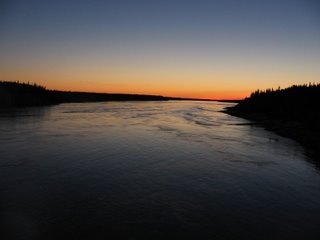
LG-1
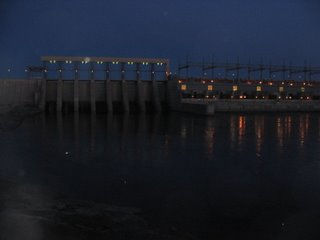
The sun completely down, we set off for the JBH. By the time we reached the highway I was freezing. The temperature had dropped close to freezing, which makes it several degrees colder at speed. We stopped to regroup, adding whatever layers we had. We also used the last of our heatpacks. It was ultimately all for not. Within 100 kilometers I could barely keep my legs from shaking, and my speed was dropping continuously, a tell-tale sign of fatigue. Soon after that I was convinced I could see frost on the trees, and the miles rolled by dreadfully slowly. What seemed like an hour would pass and we’d be just ten kilometers closer to our goal. The steady stream of northbound logging trucks soon proved a hazard, as I began to fear drifting across lanes, especially as it became more difficult to hold our lines through the corners. Then, at km 470, we hit a fog which swallowed our front wheels. It was only with good fortune that we were alongside Lake Mistanikap, dotted with Cree summer camps. We set up camp as quickly as we could. Chilled to the core, I slept in all my gear.
I woke up late the next morning. It had been an awful ride the night before. And today we had 1100 kms to home. Still, I looked forward to the challenge. Even when I pushed my head outside of the tent and proceeded to cough up a bunch of blood.
The camp in morning
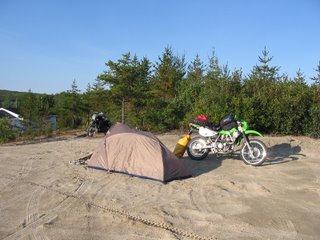
We tried to be efficient in cleaning up camp, but the long night had gotten the better of us. Sam dropped his bike in the sand twice. I almost dropped mine once (and had dropped it twice the day before). But we soon resolved ourselves to the task and set out. We rode a hard pace to Relais 381 where we would gas up for our longest stretch yet without fuel. Then, filled up on some mixture of Red Bull, ginseng, and Gatorade, we headed for Matagami. It’s hardly heavy fuel, but it will keep you eyes up on the bike.
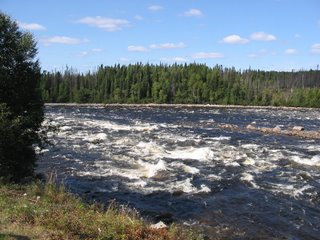
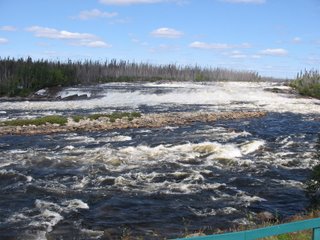
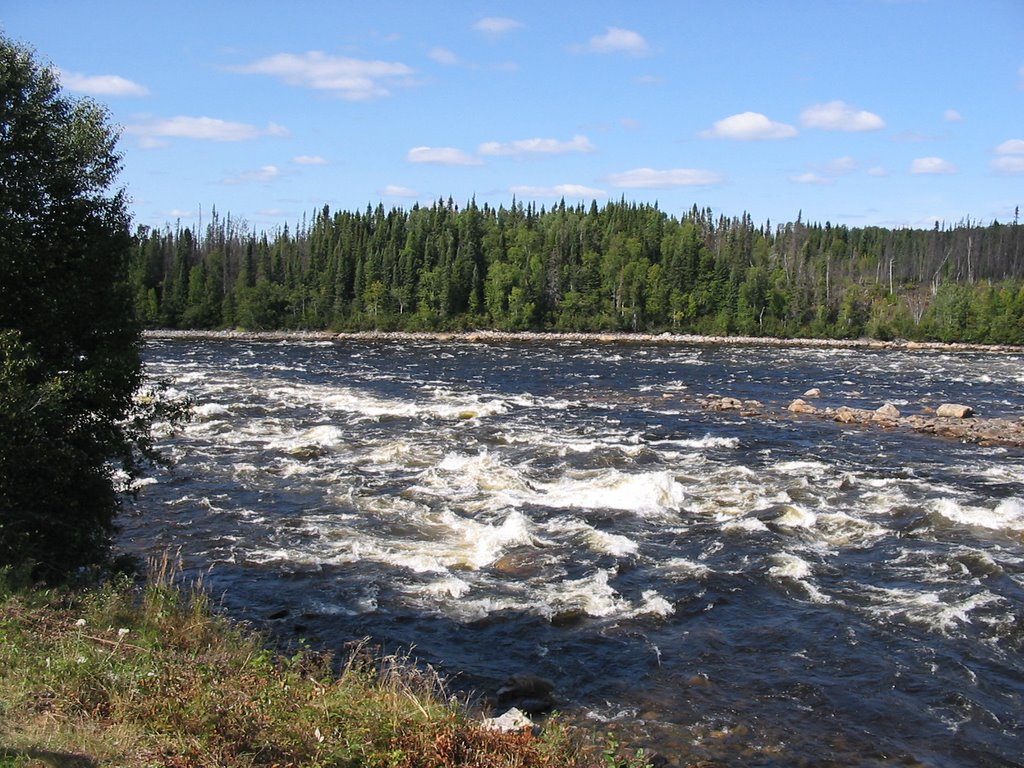
At km 257 we finally hit the Rupert. We had crossed it earlier on the North Road, but there the river was nothing like it is here. By the time the Rupert crosses the JBH is has collected much more water, as several more lakes spill into its stream. I had seen pictures before, but they did nothing to capture the scale of the rapids. It takes little to imagine the most calm line leading to smashed canoes. And it is inconceivable that one could run the roughest section of the cataracts. This is, quite literally, a deadly river. It is a kilometer of crashing. crushing rapids. There is nothing calm or serene about it. The Queen of the North, it is one of Quebec’s greatest possessions. As I’ve written below, this is not for much longer. Sam and I briefly discussed the merits of damming the river, given how much power it will provide and how much wealth will accrue to the Cree nations as a result. But it really doesn’t make up for the loss. We had little time to stay – we had to get back to jobs and studies. Life rolls on like the Rupert, apparently. Until it doesn’t.
The Rupert River
From the Rupert we rode a little less than 900 kilometers home. I rode about 80 more than Sam, on account of his bike breaking down in the Gatineaus. The cause remains unknown, despite he and I performing a number of simple tests on the roadside, guided by my dad on a cellphone. I ended up winding the last 80 kilometers home following a tow truck with Sam’s bike. It was a poor ending to an extraordinary trip, the thoughts of which keep flowing.
On the way out of Chisasibi we took a quick detour to see LG1, one of the great hydroelectric dams of northern Quebec. My eyes don’t see well at dusk, so it was a fine time to get off the bikes for a few minutes. We soon discovered that we could ride across the top of the dam, and then to a viewing platform downriver. It is hard to capture the scale of the barrage, but it is 1.3 kilometers wide and 160 meters in height.
Downstream at Le Grande

LG-1

The sun completely down, we set off for the JBH. By the time we reached the highway I was freezing. The temperature had dropped close to freezing, which makes it several degrees colder at speed. We stopped to regroup, adding whatever layers we had. We also used the last of our heatpacks. It was ultimately all for not. Within 100 kilometers I could barely keep my legs from shaking, and my speed was dropping continuously, a tell-tale sign of fatigue. Soon after that I was convinced I could see frost on the trees, and the miles rolled by dreadfully slowly. What seemed like an hour would pass and we’d be just ten kilometers closer to our goal. The steady stream of northbound logging trucks soon proved a hazard, as I began to fear drifting across lanes, especially as it became more difficult to hold our lines through the corners. Then, at km 470, we hit a fog which swallowed our front wheels. It was only with good fortune that we were alongside Lake Mistanikap, dotted with Cree summer camps. We set up camp as quickly as we could. Chilled to the core, I slept in all my gear.
I woke up late the next morning. It had been an awful ride the night before. And today we had 1100 kms to home. Still, I looked forward to the challenge. Even when I pushed my head outside of the tent and proceeded to cough up a bunch of blood.
The camp in morning

We tried to be efficient in cleaning up camp, but the long night had gotten the better of us. Sam dropped his bike in the sand twice. I almost dropped mine once (and had dropped it twice the day before). But we soon resolved ourselves to the task and set out. We rode a hard pace to Relais 381 where we would gas up for our longest stretch yet without fuel. Then, filled up on some mixture of Red Bull, ginseng, and Gatorade, we headed for Matagami. It’s hardly heavy fuel, but it will keep you eyes up on the bike.
At km 257 we finally hit the Rupert. We had crossed it earlier on the North Road, but there the river was nothing like it is here. By the time the Rupert crosses the JBH is has collected much more water, as several more lakes spill into its stream. I had seen pictures before, but they did nothing to capture the scale of the rapids. It takes little to imagine the most calm line leading to smashed canoes. And it is inconceivable that one could run the roughest section of the cataracts. This is, quite literally, a deadly river. It is a kilometer of crashing. crushing rapids. There is nothing calm or serene about it. The Queen of the North, it is one of Quebec’s greatest possessions. As I’ve written below, this is not for much longer. Sam and I briefly discussed the merits of damming the river, given how much power it will provide and how much wealth will accrue to the Cree nations as a result. But it really doesn’t make up for the loss. We had little time to stay – we had to get back to jobs and studies. Life rolls on like the Rupert, apparently. Until it doesn’t.
The Rupert River

From the Rupert we rode a little less than 900 kilometers home. I rode about 80 more than Sam, on account of his bike breaking down in the Gatineaus. The cause remains unknown, despite he and I performing a number of simple tests on the roadside, guided by my dad on a cellphone. I ended up winding the last 80 kilometers home following a tow truck with Sam’s bike. It was a poor ending to an extraordinary trip, the thoughts of which keep flowing.
Friday, September 22, 2006
Farce
Earlier, I suggested that the only thing more unscrupulous than suggesting that Canadian losses in Afghanistan were unnecessary is admitting that they are necessary but claiming someone else should do the heavy lifting. This guy crossed that line today. Count him among those whose internationalism doesn't matter when it really counts.
Thursday, September 21, 2006
James Bay Trip. Day 3: Nemaska to James Bay.
You can see the first two days of our trip here.
Sam and I woke up early in Nemaska with all the narrows covered in fog. We could only take the locals’ word about the beauty of Lake Campion.
We made a quick breakfast and packed up the bikes. We would ride another 100 kms of gravel north west, and then meet the James Bay Highway at kilometer 275. Pushing along near top speed on the gravel we ate up the road in an hour’s time.
The JBH – North Road intersection

When we reached the JBH we had only 434 kilometers to Chisasibi. It is counterintuitive how the miles accumulate when you are this isolated. When you ride through a populated area every town and rest stop reminds you that you are traveling a long distance. But left with only long sweeping curves, burned out forests, small mountains in the distance and lake after lake, the distance becomes arbitrary. Instead, the mind is on holding the finest line through the corner and keeping the bike at top speed despite admonitions to drop to 85 km/h. The KLR is a fine bike, and bulletproof. But it’s on roads like the JBH – wide-open and unpatrolled – when I wish I had a bike that could easily cruise at 150 or 160 km/h, like this or this. All in good time.
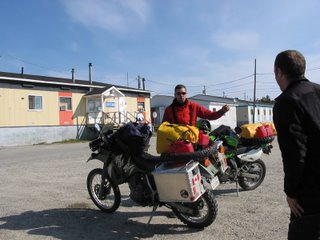
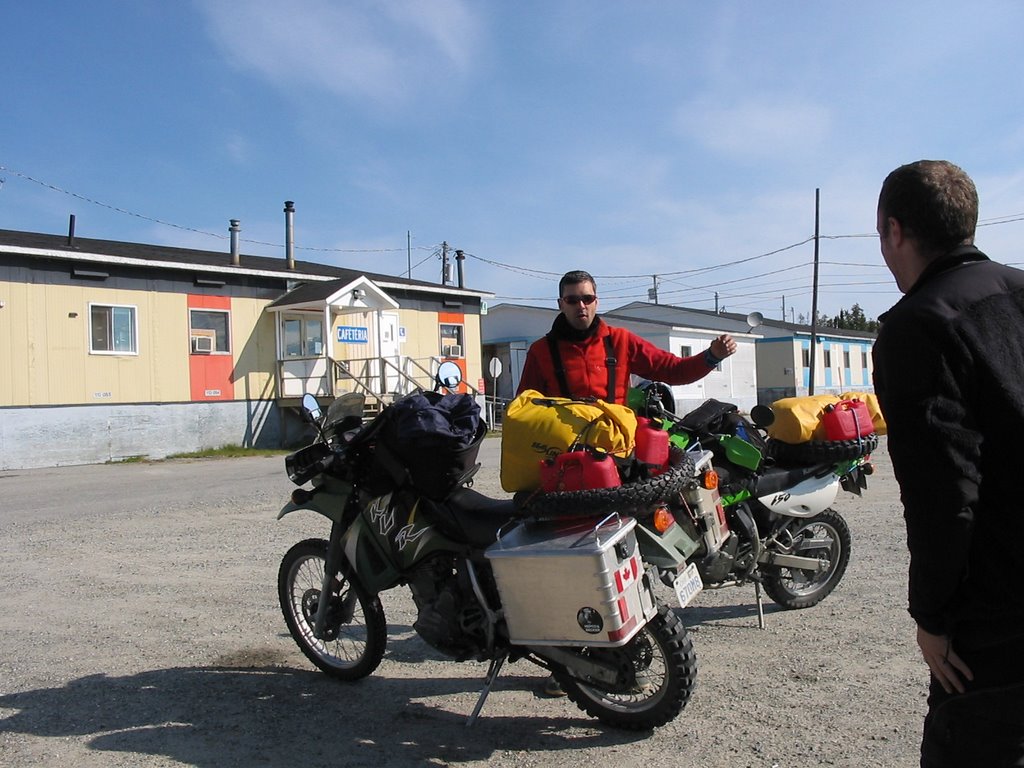
About an hour after entering the highway we came upon Relais 381. It is a town – of sorts – at kilometer 381 of the JBH. It exists to pump gas at exorbirant prices and charge $1 for two day old hard boiled eggs. Sam says it’s the crappiest town in Canada. I reserve comment.
Relais 381 on the ride back
Fuel tanks filled, we took off at just after noon for Chisasibi. On the way we passed the Trans-Taiga road, a 700 km eastward ride into the middle of nowhere. At its end you lie farther from a town than on any other road in North America. We were taken by its isolation, and pointed the bikes down it. But time would not permit the trip this time.
The start of the Trans-Taiga

We arrived three hours later. A mostly native town, Chisasibi sits 90 kilometers west of the JBH on the La Grande river, just downstream from the great LG1 hydroelectric dam, and just ten kilometers upstream from James Bay. We pushed beyond the town looking for some trail to James Bay.
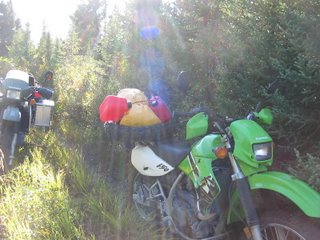
Somehow we ended up on ATV dual track which kept getting thicker and thicker, turning towards and then away from the river. When we decided this was not the way to the bay we turned around and started a back track. Anxious to get to the bay I kicked up the speed of the bike and upshifted a couple of times. Riding in deep ruts, this was a bad idea. It was only a matter of seconds before I hit a bad series of bumps and inadvertently hit the throttle. The bike rocketed ahead, then over, they into a tree. I ended up beside it and ahead of it. Laying on the trail I took a few deep breathes and gave everything the once over. Trailing not far behind, Sam inspected everything. I then made my way back to the bike, which fared better than the tree. The front wheel and fork where fine. Nothing was broken, and the mirrors but needed adjustment. At this point I got mad at Sam for not taking pictures of the crash. He wanted to make sure I was fine before snapping pics. That’s what friends are for, apparently.
The bike after the crash
Back at speed, we left the trail and then found the three lane wide dirt road which leads to the Bay. Apparently our observational skills match our navigational skills.
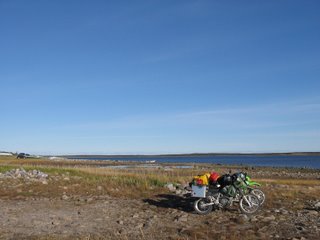
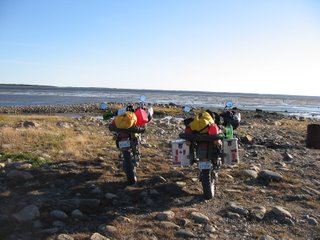
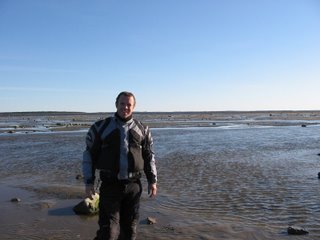
We passed a steady stream of pick up trucks and cars on our way to the Bay, and arrived after ten minutes. All the riding had been worth it. I cannot imagine a better scene. The water stretches past the horizon, the sky goes on forever, rocks come up from the water at low tide, and fishing boats and drying racks dot the shore. The flow of Le Grande is great enough that you can taste just a trace of salt in the water. We considered cooking dinner on the shore, but the air was getting colder and we knew we had a long ride to the Rupert River at km 257, where we hoped to spend the night. So we decided on dinner in Chisasibi and a long ride through the night to the Rupert. We’d never make it that far.
James Bay
Sam and I woke up early in Nemaska with all the narrows covered in fog. We could only take the locals’ word about the beauty of Lake Campion.
We made a quick breakfast and packed up the bikes. We would ride another 100 kms of gravel north west, and then meet the James Bay Highway at kilometer 275. Pushing along near top speed on the gravel we ate up the road in an hour’s time.
The JBH – North Road intersection

When we reached the JBH we had only 434 kilometers to Chisasibi. It is counterintuitive how the miles accumulate when you are this isolated. When you ride through a populated area every town and rest stop reminds you that you are traveling a long distance. But left with only long sweeping curves, burned out forests, small mountains in the distance and lake after lake, the distance becomes arbitrary. Instead, the mind is on holding the finest line through the corner and keeping the bike at top speed despite admonitions to drop to 85 km/h. The KLR is a fine bike, and bulletproof. But it’s on roads like the JBH – wide-open and unpatrolled – when I wish I had a bike that could easily cruise at 150 or 160 km/h, like this or this. All in good time.
About an hour after entering the highway we came upon Relais 381. It is a town – of sorts – at kilometer 381 of the JBH. It exists to pump gas at exorbirant prices and charge $1 for two day old hard boiled eggs. Sam says it’s the crappiest town in Canada. I reserve comment.
Relais 381 on the ride back
Fuel tanks filled, we took off at just after noon for Chisasibi. On the way we passed the Trans-Taiga road, a 700 km eastward ride into the middle of nowhere. At its end you lie farther from a town than on any other road in North America. We were taken by its isolation, and pointed the bikes down it. But time would not permit the trip this time.
The start of the Trans-Taiga

We arrived three hours later. A mostly native town, Chisasibi sits 90 kilometers west of the JBH on the La Grande river, just downstream from the great LG1 hydroelectric dam, and just ten kilometers upstream from James Bay. We pushed beyond the town looking for some trail to James Bay.
Somehow we ended up on ATV dual track which kept getting thicker and thicker, turning towards and then away from the river. When we decided this was not the way to the bay we turned around and started a back track. Anxious to get to the bay I kicked up the speed of the bike and upshifted a couple of times. Riding in deep ruts, this was a bad idea. It was only a matter of seconds before I hit a bad series of bumps and inadvertently hit the throttle. The bike rocketed ahead, then over, they into a tree. I ended up beside it and ahead of it. Laying on the trail I took a few deep breathes and gave everything the once over. Trailing not far behind, Sam inspected everything. I then made my way back to the bike, which fared better than the tree. The front wheel and fork where fine. Nothing was broken, and the mirrors but needed adjustment. At this point I got mad at Sam for not taking pictures of the crash. He wanted to make sure I was fine before snapping pics. That’s what friends are for, apparently.
The bike after the crash

Back at speed, we left the trail and then found the three lane wide dirt road which leads to the Bay. Apparently our observational skills match our navigational skills.
We passed a steady stream of pick up trucks and cars on our way to the Bay, and arrived after ten minutes. All the riding had been worth it. I cannot imagine a better scene. The water stretches past the horizon, the sky goes on forever, rocks come up from the water at low tide, and fishing boats and drying racks dot the shore. The flow of Le Grande is great enough that you can taste just a trace of salt in the water. We considered cooking dinner on the shore, but the air was getting colder and we knew we had a long ride to the Rupert River at km 257, where we hoped to spend the night. So we decided on dinner in Chisasibi and a long ride through the night to the Rupert. We’d never make it that far.
James Bay


Juste un petit question
When Bob Rae travelled to Iraq to help the Kurds set up a constitution, did he mention that the war which liberated them was a big sham which he thinks should not have occurred?
Wednesday, September 20, 2006
Small pleasures, pt 2
Three small pleasures:
1.) When you realise that You Forgot It In People is exactly the length of time it takes to walk door to door from home to office;
2.) When someone like this teaches you more about research design in five minutes then you can figure out in five days;
3.) And when people like this and this and this and this make a paper you've been working on for a year several times better by taking an hour to read and comment.
Subscribe to:
Posts (Atom)